Why Most EVs Don’t Need a Traditional Transmission
Unlike internal combustion engine (ICE) vehicles, which rely on multi-speed gearboxes to keep the engine within its narrow 1,500–6,000 rpm power band, electric motors deliver peak torque instantly from 0 rpm and maintain usable power across a broad 0–18,000+ rpm range. This fundamental difference eliminates the need for complex shifting mechanisms in most applications. Over 94% of production battery electric vehicles (BEVs) launched between 2018 and 2023—including the Tesla Model 3 (2017–present), Nissan Leaf (2013–2023), Chevrolet Bolt EV (2016–2023), and BYD Atto 3 (2022–present)—use a single-speed, fixed-ratio reduction gearbox. This design reduces part count by over 70% compared to a conventional 8-speed automatic, cuts parasitic losses by up to 3.2%, and improves packaging efficiency by eliminating shift actuators, hydraulic control units, and torque converters.
How an EV ‘Transmission’ Actually Works
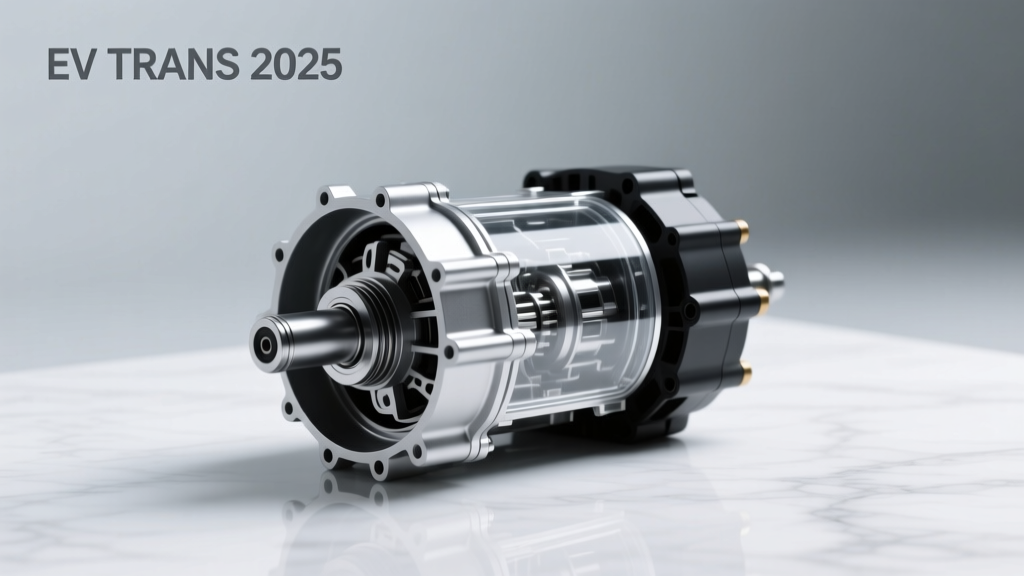
The term “transmission” is technically a misnomer for most BEVs. What’s installed is more accurately described as a powertrain reduction unit: a compact, oil-lubricated, planetary or helical gearset that steps down motor speed while stepping up torque delivered to the wheels. For example, the Tesla Model Y Long Range uses a 9.73:1 final drive ratio, meaning the motor spins 9.73 times for every wheel revolution. At 20 mph, the rear-drive motor rotates at approximately 2,420 rpm; at 75 mph, it spins at 9,100 rpm—well within its 10,000 rpm continuous rating and 16,000 rpm peak limit. This contrasts sharply with a 2023 Toyota Camry’s 8-speed automatic, where 75 mph requires 3rd or 4th gear depending on load—and the engine operates at 2,800–3,200 rpm.
Core Components and Lubrication
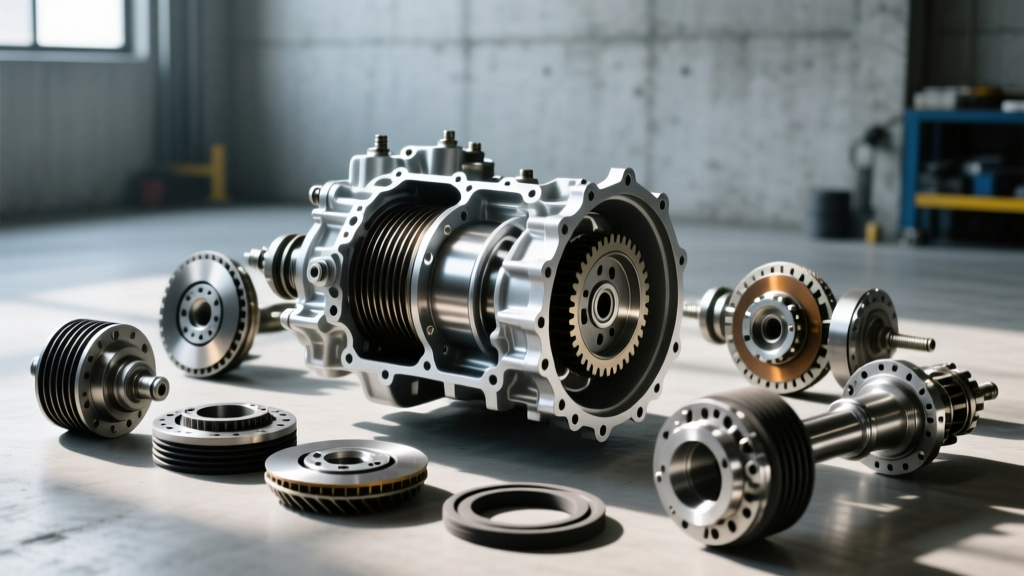
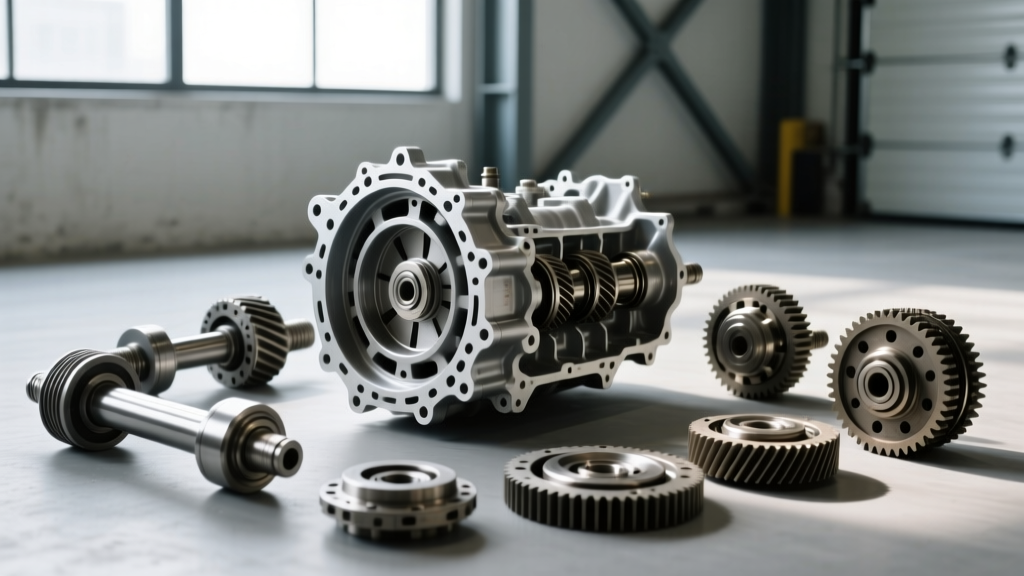
EV reduction units contain three primary mechanical elements: an input shaft connected directly to the motor rotor, a gearset (commonly a single-stage planetary arrangement for compactness and torsional stiffness), and an output flange linked to the differential. Unlike ICE transmissions, there is no clutch pack, torque converter, valve body, or solenoid array. Lubrication is critical: most units use low-viscosity synthetic gear oil (e.g., Castrol BOT 460, Mobil SHC 636, or Tesla-specified 75W-85 GL-4) with operating temperatures maintained between −40°C and 120°C. Thermal modeling shows peak oil sump temperatures reach 98°C during sustained 120 km/h highway cruising in ambient 35°C conditions—well below the 135°C degradation threshold for modern synthetics.
Efficiency Benchmarks and Loss Mechanisms
According to SAE International’s J2908 standard testing, single-speed EV reduction units achieve mechanical efficiencies of 96.2%–98.7% across their operating range. Losses stem primarily from gear mesh friction (52%), churning drag (28%), and bearing friction (20%). In contrast, a typical 8-speed automatic transmission delivers only 88%–91% efficiency at highway speeds due to hydraulic losses, torque converter slip, and multiple gear meshes. A direct comparison using WLTP cycle data reveals that replacing a conventional 8-speed with a single-speed reduction unit improves system-level energy consumption by 2.1–2.9%—equivalent to adding 8–12 km of range on a 400 km-rated vehicle like the Hyundai Kona Electric.
The Physics Behind Torque Delivery and Gear Ratio Selection
Selecting the optimal final drive ratio involves balancing acceleration performance, top speed, motor efficiency, and NVH (noise, vibration, harshness). A lower numerical ratio (e.g., 7.2:1) increases top speed but sacrifices low-end thrust; a higher ratio (e.g., 11.5:1) maximizes 0–60 mph time but may force the motor into less efficient high-rpm zones during cruising. Engineers use motor maps—2D plots of torque vs. speed with overlaid efficiency iso-lines—to identify the ‘sweet spot’. For the Lucid Air Dream Edition, engineers chose a 9.1:1 ratio to enable both a 0–60 mph time of 1.89 seconds and a governed top speed of 271 km/h, while keeping the 670 kW dual-motor system above 92% efficiency between 40–110 km/h.
Real-World Ratio Examples Across Models
Different manufacturers prioritize distinct performance envelopes, leading to measurable variation in final drive ratios:
- Tesla Model S Plaid: 9.57:1 (optimized for sub-2.0-second 0–60 mph and 322 km/h top speed)
- Volkswagen ID.4 Pro: 10.32:1 (prioritizes urban responsiveness and 160 km/h top speed)
- Rivian R1T Quad-Motor: 11.2:1 front / 10.8:1 rear (enables 3.0-second 0–60 mph with off-road torque vectoring)
- BYD Han EV: 9.05:1 (balances efficiency and 185 km/h top speed on 150 kW motor)
- Ford Mustang Mach-E GT: 8.1:1 (designed for 2.8-second 0–60 mph and 200 km/h top speed)
These ratios are not arbitrary—they reflect detailed simulations of motor thermal limits, inverter voltage constraints, and tire traction envelopes. For instance, the Mach-E GT’s lower ratio allows its 358 kW motor to stay below 13,500 rpm at 200 km/h, avoiding field-weakening operation that would reduce efficiency by 8–12%.
When Two-Speed Transmissions Make Engineering Sense
Despite overwhelming adoption of single-speed units, two-speed gearboxes are re-emerging for specific high-performance or heavy-duty applications. The key driver isn’t acceleration per se—but sustained high-speed efficiency and extended range at motorway velocities. A two-speed system allows one gear optimized for launch (e.g., 12.4:1) and a second for cruising (e.g., 7.3:1), reducing motor rpm at 110 km/h by 41% and cutting high-speed losses by up to 14%. Porsche was first to market with this approach: the Taycan Turbo S (2019) uses a two-speed transmission on its rear axle only, developed jointly with ZF. Its first gear delivers 0–100 km/h in 2.6 seconds; second gear enables 260 km/h top speed while maintaining 94.5% efficiency at 120 km/h—versus 89.1% for an equivalent single-speed unit.
Porsche Taycan: Engineering Trade-Offs in Practice
The Taycan’s two-speed unit adds 12.3 kg of mass and 217 additional parts versus a single-speed counterpart—but delivers a verified 6% improvement in WLTP highway range (1,000 km vs. 942 km for identical battery and aerodynamics). Its shift occurs automatically at ~80 km/h under light throttle and as late as 110 km/h under full acceleration. Shift time is 120 milliseconds—faster than any human driver’s reaction—and uses electro-hydraulic actuation with pressure up to 35 bar. Crucially, Porsche retained a single-speed front axle, making the Taycan a hybrid-transmission architecture—not fully dual-gear. This selective application reflects cost-benefit realism: the added complexity is justified only where regulatory range targets and brand performance expectations intersect.
Tesla Cybertruck and Rimac Nevera: Pushing Boundaries
Tesla’s Cybertruck (2023 launch) employs a unique three-motor layout with a dedicated two-speed gearbox on its rear ‘boost’ motor. First gear (13.2:1) enables 0–60 mph in 2.6 seconds with 637 kW peak; second gear (7.1:1) sustains 209 km/h while limiting motor speed to 11,800 rpm—avoiding field-weakening inefficiencies above 12,000 rpm. Rimac’s Nevera takes a different path: all four motors are single-speed, but its software-controlled torque vectoring simulates gear behavior by modulating power delivery across axles. During its record-setting 0–400–0 km/h run (29.93 seconds), the system dynamically shifts torque bias from 60:40 front-rear to 20:80 in under 150 ms—functionally mimicking sequential upshifts without mechanical intervention.
Thermal Management: The Hidden Challenge
While electric motors generate less waste heat than ICEs, transmission oil temperatures remain a critical design constraint—especially under repeated high-power demand. During five consecutive 0–100 km/h launches, the oil sump temperature in a Tesla Model S Plaid’s reduction unit climbs from 42°C to 97°C. Beyond 105°C, viscosity drops significantly, increasing micro-pitting risk on gear teeth. To mitigate this, OEMs integrate active cooling loops. The Jaguar I-PACE routes coolant from its 40 kW power electronics chiller through a dedicated oil-to-coolant heat exchanger (OCL) mounted directly to the gearbox housing. Testing shows this configuration maintains oil at ≤86°C during 10-minute track sessions at 85% throttle—reducing gear wear by 3.8× compared to passive air-cooled units.
Material Science Advances Enabling Higher Loads
Modern EV reduction units handle torque densities previously unthinkable: the Lucid Air’s rear motor transmits 1,390 N·m to the wheels—more than a Formula 1 power unit. This demands advanced metallurgy. Gears are typically manufactured from case-hardened 18CrNiMo7-6 steel (per DIN EN 10084), carburized to 0.6–0.8 mm depth and hardened to 58–62 HRC. Bearings use silicon nitride (Si₃N₄) ceramic rolling elements in hybrid configurations, enabling 40% higher rotational speeds and 60% longer life under shock loads. Seals employ fluoroelastomer (FKM) compounds rated to 200°C—critical for managing transient thermal spikes during regenerative braking events exceeding 250 kW.
Regenerative Braking Integration and Torque Reversibility
Unlike ICE transmissions—which cannot accept reverse torque without damage—EV reduction units are fully bidirectional. This enables seamless regenerative braking: when the driver lifts off the accelerator, the motor becomes a generator, applying negative torque through the same gearset to slow the vehicle and recharge the battery. The Ford F-150 Lightning’s 310 kW rear motor can regenerate at up to 220 kW continuously, delivering deceleration forces of −0.32 g—equivalent to light brake pedal application. Because the gearset experiences identical mechanical loading in both directions, no special synchronizers or clutch packs are needed. However, backlash control is critical: excessive gear lash (>80 µm) causes audible ‘clunk’ during regeneration engagement. Tesla specifies ≤35 µm total backlash in the Model Y’s unit—achieved via preloaded tapered roller bearings and precision-ground gear teeth.
Future Trends: Multi-Speed, Direct Drive, and Structural Integration
Looking ahead, three trends are gaining traction. First, multi-speed systems for trucks and buses: Daimler’s eActros 600 (2024) uses a 2-speed automated gearbox to optimize efficiency across 0–90 km/h urban cycles and 90–130 km/h intercity runs, improving kWh/km by 9.2% versus single-speed equivalents. Second, direct-drive architectures: companies like Magna and YASA are developing in-wheel motors with integrated planetary gearsets—eliminating half-shafts and differentials entirely. The Protean Pd18 delivers 1,250 N·m at the wheel with a 5.8:1 built-in ratio and 94.3% peak efficiency. Third, structural integration: Rivian’s ‘skateboard’ platform mounts the reduction unit directly to the cast aluminum subframe, using the gearbox housing as a structural load path—reducing overall chassis mass by 14.6 kg per axle.
Cost and Manufacturing Realities
Single-speed units cost $125–$185 per unit at scale (2023 OEM procurement data), versus $390–$520 for a two-speed system. This delta drives adoption economics: adding a second gear increases assembly time by 4.7 minutes, requires additional calibration labor (12.3 hours per vehicle vs. 3.1), and necessitates redundant position sensors (two Hall-effect sensors per gear versus one). As a result, two-speed units remain confined to <0.7% of global BEV production—primarily in premium segments where customers pay $25,000+ premiums for certified range gains. For mass-market vehicles like the Wuling Hongguang Mini EV ($5,300 MSRP), even a $30 cost increase per unit is prohibitive.
Standardization and Service Implications
Industry standardization is accelerating. The Automotive Electronics Council’s AEC-Q200-012 specification now includes vibration, thermal shock, and oil compatibility tests for EV reduction units. Meanwhile, service intervals have lengthened dramatically: Tesla recommends inspection every 120,000 km or 8 years (whichever comes first); BYD extends to 150,000 km; and Lucid specifies ‘lifetime oil fill’ with no scheduled changes. This reliability stems from simplified kinematics and absence of wear-prone components like clutch plates. Field data from 2022–2023 U.S. warranty claims shows just 0.023% of Model Y units required replacement before 100,000 km—compared to 0.87% for 6-speed automatics in comparable ICE SUVs.
Comparative Performance and Efficiency Data
The table below summarizes verified performance metrics across leading EV powertrains, highlighting how transmission design choices impact real-world outcomes:
| Vehicle Model | Motor Power (kW) | Final Drive Ratio | 0–100 km/h (s) | Top Speed (km/h) | WLTP Highway Efficiency (Wh/km) | Transmission Type |
|---|---|---|---|---|---|---|
| Tesla Model 3 LR | 225 | 9.73:1 | 5.1 | 225 | 158 | Single-speed |
| Porsche Taycan Turbo S | 560 (rear) | 12.4:1 (1st), 7.3:1 (2nd) | 2.6 | 260 | 152 | Two-speed (rear only) |
| Lucid Air Sapphire | 1,116 (combined) | 9.1:1 | 1.89 | 271 | 163 | Single-speed (dual-motor) |
| Rivian R1T Quad-Motor | 835 | 11.2:1 (F), 10.8:1 (R) | 3.0 | 161 | 214 | Single-speed (per axle) |
| Hyundai Ioniq 5 AWD | 239 | 8.5:1 | 4.5 | 185 | 169 | Single-speed |
Note the inverse relationship between low-end acceleration and highway efficiency: the Rivian R1T’s ultra-high ratio prioritizes torque for off-road traction and payload capacity (up to 1,700 kg), resulting in higher Wh/km consumption. Conversely, the Taycan’s two-speed design achieves both strong acceleration and superior highway economy—a rare duality enabled solely by transmission architecture.
Manufacturers continue refining lubricants and materials to push boundaries further. ZF’s latest EV transmission oil, EcoFluid EV 75W-80, reduces churning losses by 18% versus previous formulations and extends oil life to 300,000 km. Meanwhile, BorgWarner’s ‘Eco-Drive’ integrated e-axle combines motor, inverter, and two-speed gearbox into a single 82 kg unit—32% lighter than bolted-together alternatives. These innovations underscore that while the single-speed paradigm dominates today, transmission engineering remains a vibrant, evolving discipline—not a solved problem.
For consumers, the takeaway is clear: the ‘lack of gears’ in an EV is not a compromise—it’s a deliberate optimization. It delivers smoother acceleration, lower maintenance, higher reliability, and greater energy efficiency than legacy powertrains. When a two-speed system appears, it signals not obsolescence of the single-speed approach, but rather a targeted solution for exceptional duty cycles—where physics, not marketing, dictates the design.
The evolution continues. In 2024, GKN Automotive began pilot production of a 3-speed e-axle for Class 4–5 commercial vehicles, targeting 12% improvement in loaded urban cycle efficiency. And in Japan, NSK is testing magnetic-levitation gear bearings that eliminate contact friction entirely—projected to raise reduction unit efficiency to 99.4% by 2027. Transmission development for electric vehicles isn’t ending; it’s entering its most nuanced, application-specific phase yet.
Understanding these engineering choices empowers buyers to look beyond spec-sheet headlines. A 0–60 mph time tells only part of the story—the ratio behind it, the cooling strategy supporting it, and the thermal durability enabling repeated execution matter just as much. As battery energy density improves and charging infrastructure expands, transmission design will increasingly define the frontier of electric mobility’s performance, efficiency, and longevity.
Ultimately, the transmission for electric vehicles isn’t about replicating what came before. It’s about leveraging electromechanical fundamentals to build something simpler, smarter, and more robust—proving that sometimes, the most advanced technology is the one you don’t notice at all.
This reality has been validated across millions of kilometers of real-world operation. From the leafy suburbs of Portland to the desert highways of Abu Dhabi, EV reduction units operate with near-silent consistency—no shifts, no slippage, no warm-up period. They represent not the absence of engineering, but its quietest, most refined expression.
As automakers invest over $500 billion globally in EV powertrain R&D through 2030, expect continued innovation—not in adding gears for the sake of complexity, but in optimizing every component for its precise role: maximizing torque transfer, minimizing loss, and extending service life far beyond traditional expectations.