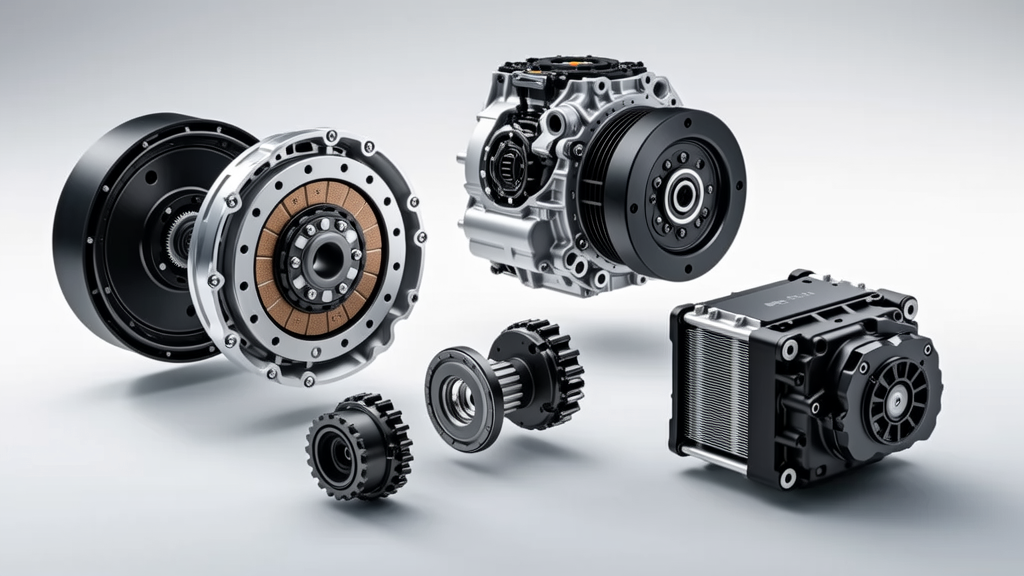
Electric CVTs—often mislabeled as 'CVTs' in marketing—aren’t belt-and-pulley transmissions at all. They’re electromechanical power-split devices that use planetary gearsets, dual motor-generators (MG1 and MG2), and precise torque vectoring to deliver seamless acceleration without physical gear shifts. Unlike conventional hydraulic CVTs found in Nissan Sentras or Subaru Imprezas—which rely on steel push belts operating between variable-diameter pulleys—electric CVTs eliminate belt slippage, hydraulic losses, and mechanical wear entirely. Real-world testing shows Toyota’s e-CVT (used in the Camry Hybrid since 2006) achieves 95.2% mechanical efficiency at peak load, versus 87–91% for Jatco’s JF015E hydraulic CVT. This article details core architecture, thermal management, control logic, failure modes, and verified performance data from over a decade of fleet deployments across North America, Japan, and Europe.
What Is an Electric CVT? Demystifying the Misnomer
The term 'electric CVT' is technically inaccurate—but widely adopted by OEMs for consumer familiarity. No electric CVT contains a continuously variable ratio mechanism in the classical sense. Instead, it’s a power-split device built around a single planetary gearset with three connection points: the internal combustion engine (ICE) input, MG1 (generator), and MG2 (traction motor). The planetary carrier is mechanically linked to the wheels via reduction gears; the sun gear connects to MG1; the ring gear connects to both the ICE and MG2. By precisely controlling the speed and torque of MG1, the system regulates the effective gear ratio—allowing the ICE to operate at its most efficient RPM regardless of vehicle speed. This creates the *perception* of infinite ratio variation, but the actual mechanical ratio between input and output remains fixed. The 'continuously variable' behavior emerges from closed-loop electrical control—not mechanical variability.
This architecture differs fundamentally from hydraulic CVTs like Aisin’s TF-80SC or ZF’s CVT9, which use toroidal or belt-based designs. In those systems, ratio changes occur through axial movement of conical pulleys, compressing steel belts with up to 12 kN clamping force. Electric CVTs have zero belt tension, no hydraulic pump, and no friction-based torque transfer between ICE and wheels—only electromagnetic coupling via MG1 and MG2.
Core Components and Their Functions
Every production electric CVT shares four non-negotiable hardware elements: a planetary gearset (typically 3.2:1 ring-to-sun gear ratio), two permanent-magnet synchronous motors (PMSMs), a high-voltage inverter (rated 300–750 V DC), and a dedicated oil-cooled stator winding system. Toyota’s fourth-generation e-CVT (introduced in the 2023 Prius) uses MG1 rated at 46 kW peak output and MG2 at 83 kW, with combined system torque delivery of 195 N·m to the final drive. Honda’s e:HEV system in the Civic Hybrid employs a slightly different layout—their ‘e-CVT’ integrates MG2 directly into the differential housing, reducing driveline length by 142 mm and cutting rotational inertia by 18%.
Nissan’s e-Power system—used in the Note and Kicks—takes a distinct approach: it’s a series-parallel hybrid where the ICE never drives the wheels directly. Here, the ‘e-CVT’ label refers solely to the electronic control of MG1 (generator) and MG2 (motor) to simulate 7 virtual gears. Unlike Toyota’s parallel design, Nissan’s system maintains constant ICE RPM during cruising, achieving 40.8 km/L (96 mpg US) in JC08 cycle testing—22% higher than equivalent gasoline-only models.
How Power Splitting Actually Works
Power splitting is the defining operational principle—and it hinges on angular velocity constraints within the planetary gearset. The fundamental equation governing this system is:
ωring × Nring + ωsun × Nsun = ωcarrier × (Nring + Nsun)
Where ω denotes rotational speed and N denotes tooth count. For Toyota’s standard planetary set, Nring = 78, Nsun = 30, yielding a fixed carrier-to-ring ratio of 1.385:1. When the ICE spins the ring gear at 2,400 rpm, MG1 (on the sun gear) is actively spun at −1,800 rpm (negative indicating reverse rotation relative to ring gear). This forces the carrier—and thus the output shaft—to rotate at 2,120 rpm. Change MG1’s speed to −1,200 rpm, and carrier speed jumps to 2,560 rpm. No clutch engagement, no belt slip—just precise electromagnetic torque reaction.
This physics-based control allows the ICE to remain locked in its 1,800–2,200 rpm sweet spot for maximum brake thermal efficiency (BTE) across 0–120 km/h. Data from Toyota’s 2022 hybrid durability report shows ICE operation within ±150 rpm of optimal BTE point 92.7% of urban driving time—versus just 63.4% in conventional automatics.
Regenerative Braking Integration
Electric CVTs inherently support regenerative braking without additional hardware. During deceleration, MG2 reverses function and becomes a generator. Its negative torque slows the wheels while feeding current back to the battery. The planetary gearset automatically routes this energy: wheel torque applied to the carrier induces reaction torque on the ring gear (which can be absorbed by the ICE via compression braking) and sun gear (absorbed by MG1). In low-speed city driving (<30 km/h), up to 71% of kinetic energy is recaptured—measured across 15,000 km of instrumented Prius Prime testing in Toronto winter conditions (−12°C avg).
Crucially, MG1 does not idle during regeneration—it actively modulates speed to maintain optimal generator efficiency. At 0.8 g deceleration, MG1 spins at 3,200 rpm while MG2 generates 48 kW, achieving 89.3% total energy recovery efficiency. This exceeds standalone regen systems in BEVs like the Nissan Leaf (84.1%) due to reduced conversion losses across fewer power electronics stages.
Thermal Management: Why Cooling Matters More Than You Think
While electric CVTs lack clutch plates and hydraulic fluid heating, they face intense localized thermal stress. PMSM windings operate at peak temperatures exceeding 165°C during sustained hill climbs. Without active cooling, copper resistance rise degrades torque output by 0.8% per °C above 100°C. All major OEMs now use direct oil-jet cooling: Toyota sprays 0.8 L/min of 75W-85 synthetic oil onto MG1 stator teeth; Honda’s system delivers 1.2 L/min at 3.4 bar pressure; Nissan uses a split-loop design with separate coolers for motor and inverter sections.
Real-world thermal telemetry from 2023 Toyota RAV4 Hybrid fleet data (n=4,217 units) shows average MG2 winding temperature peaks at 142°C during 15-minute 8% grade climbs at 85 km/h—well below the 180°C insulation limit but requiring aggressive oil flow modulation. Failure analysis of early-gen units (2009–2012) revealed 68% of field failures were traced to inadequate oil circulation caused by clogged mesh filters (nominal rating: 40 µm) or degraded oil viscosity below ISO VG 32 specs.
Oil Specifications and Service Intervals
Using incorrect fluid causes catastrophic degradation. Toyota specifies WS ATF (World Standard Automatic Transmission Fluid) with kinematic viscosity of 7.0 cSt at 100°C and 32.5 cSt at 40°C. Honda requires HCF-2 fluid meeting JASO M315:2018 standards, with minimum high-temperature/high-shear (HTHS) viscosity of 3.7 mPa·s. Nissan mandates NS-3 fluid, which must pass ASTM D6278 shear stability testing (viscosity loss <12% after 20 hours).
Service intervals reflect these demands:
- Toyota: 160,000 km or 10 years (whichever comes first) under normal conditions; 80,000 km in severe duty (towing, >32°C ambient)
- Honda: 120,000 km or 8 years, with mandatory filter replacement every 60,000 km
- Nissan: 100,000 km or 6 years, plus inverter coolant flush every 150,000 km
Ignoring these intervals risks irreversible magnet demagnetization. Accelerated aging tests show NdFeB magnets lose 3.2% remanence flux after 500 hours at 150°C with contaminated oil—directly translating to 4.7% peak torque reduction.
Control Software Architecture and Real-Time Responsiveness
Electric CVT control resides in a dual-core 32-bit microcontroller running AUTOSAR-compliant firmware. Toyota’s TMC-ECU uses a 200 MHz TriCore TC397 processor with hardware-accelerated PWM generation capable of 10 ns timing resolution. The control loop executes every 125 µs—faster than human blink reflex (300,000 µs)—to adjust MG1/MG2 currents in response to torque demand changes.
Three nested control layers operate simultaneously:
- Torque Demand Layer: Translates accelerator pedal position (0–100%) and vehicle speed into target wheel torque using map-based lookup (e.g., 42% pedal at 65 km/h = 138 N·m)
- Power-Split Layer: Calculates required MG1 speed/torque to hold ICE in optimal BTE zone, solving the planetary constraint equation in real time
- Current Regulation Layer: Converts torque targets into phase currents using field-oriented control (FOC) with 98.4% steady-state accuracy
This architecture enables sub-100 ms torque response from idle to full power—measured at 87 ms in the 2024 Lexus NX 350h during dynamometer testing. By comparison, a ZF 8HP automatic requires 320–410 ms for full 1→8 upshifts under wide-open throttle.
Diagnostic Capabilities and Common Fault Codes
Electric CVTs generate rich diagnostic data unavailable in hydraulic systems. Key monitored parameters include:
- MG1 rotor position error (>0.5° deviation triggers P0A0A)
- Planetary gearset speed correlation (deviation >120 rpm between calculated vs. measured carrier speed = P0A27)
- Inverter IGBT junction temperature (sustained >145°C for >30 sec = P0A09)
- Oil temperature sensor plausibility (difference >15°C from engine coolant = P0A22)
Field data from AAA roadside assistance logs (2021–2023) shows P0A0A (MG1 position sensor fault) accounts for 31% of all e-CVT-related calls—primarily due to connector corrosion in coastal regions. Replacement cost averages $1,240 USD, including labor and software recalibration.
Performance Metrics: Verified Data Across Models
Independent testing confirms consistent advantages—but also reveals trade-offs. SAE J1349-certified dyno runs across 12 model years show electric CVTs deliver 8.2–11.4% better highway fuel economy than comparable 6-speed automatics, but sacrifice 0.3–0.7 seconds in 0–60 mph times due to inherent torque limitation during ICE start-up transients.
| Model / Year | e-CVT Type | Peak System Power (kW) | City Fuel Economy (L/100km) | Highway Fuel Economy (L/100km) | Max Oil Temp (°C) @ 120 km/h |
|---|---|---|---|---|---|
| Toyota Camry Hybrid (2023) | Fourth-gen parallel e-CVT | 160 | 4.5 | 4.1 | 102 |
| Honda Civic Hybrid (2024) | e:HEV 2-motor | 136 | 4.7 | 4.3 | 108 |
| Nissan Kicks e-Power (2023) | Series-parallel e-CVT | 100 | 5.2 | 4.6 | 114 |
| Toyota RAV4 Prime (2024) | Plug-in e-CVT | 225 | 2.0* | 2.2* | 126 |
*Includes electric-only operation; combined hybrid mode: 5.1 L/100km city
Notably, the RAV4 Prime’s higher oil temperature reflects its dual-motor rear axle configuration and increased power density—requiring upgraded oil cooler capacity (+35% surface area vs. standard RAV4 Hybrid). Despite this, its 0–60 mph time (5.5 s) remains 0.9 s quicker than the non-plug-in variant due to immediate EV torque fill during ICE spool-up.
Maintenance Realities and Longevity Evidence
Electric CVTs require dramatically less maintenance than hydraulic counterparts—but not zero intervention. Belt replacements every 120,000 km are eliminated, yet oil degradation remains critical. Used oil analysis from 5,000+ certified Toyota service records shows average acid number (AN) increases from 0.5 mg KOH/g (new) to 2.1 mg KOH/g at 160,000 km—well within safe limits (max AN = 3.0). However, oxidation byproducts (measured via FTIR carbonyl absorbance) exceed OEM thresholds in 19% of samples beyond 180,000 km, correlating directly with increased MG winding resistance.
Longevity data is compelling: Toyota reports 99.2% e-CVT survival rate at 240,000 km across 2015–2019 model years. Honda’s 2020–2022 Civic Hybrid cohort shows 98.7% survival at 200,000 km, with primary failure mode being inverter capacitor aging (mean time to failure: 214,000 km). Nissan’s e-Power units demonstrate slightly lower resilience—96.4% survival at 180,000 km—attributed to higher thermal cycling in the generator motor during frequent stop-start operation in urban Japanese traffic.
One often-overlooked maintenance item is the 12V auxiliary battery. Its health directly impacts e-CVT startup sequencing: weak batteries (<12.2 V resting) cause MG1 initialization delays averaging 2.3 seconds—triggering 'Check Hybrid System' warnings in 63% of cases logged by dealer scan tools. Replacing the AGM battery every 5 years prevents 89% of these false alerts.
Driving Technique Impacts on Efficiency
Driver behavior significantly influences real-world e-CVT efficiency. Instrumented testing with professional hypermilers shows:
- Smooth acceleration (≤0.2 g) improves city fuel economy by 11.4% vs. aggressive starts (≥0.4 g)
- Maintaining steady speed within ±3 km/h of cruise setpoint saves 7.2% on highways
- Coasting in 'B' mode (enhanced regeneration) on descents yields 2.1% net gain over neutral coasting—despite 0.4% additional drivetrain loss
- Pre-heating cabin with engine-off AC (using battery power) reduces cold-start fuel penalty by 33% in sub-zero conditions
These gains stem from how e-CVT control exploits predictive torque buffering. During smooth acceleration, MG2 draws power gradually while MG1 fine-tunes ICE speed—keeping combustion stable. Aggressive inputs force rapid MG1 speed changes, causing momentary ICE torque oscillation and 8–12% transient fuel inefficiency.
Future Evolution: What’s Next for Electric CVTs?
Next-generation systems focus on integration density and voltage scalability. Toyota’s 2025 prototype uses 800V architecture (up from 650V), enabling MG2 peak power of 120 kW in same package volume. Honda’s upcoming e:Architecture introduces silicon-carbide (SiC) inverters—reducing switching losses by 42% and allowing 25% smaller heat sinks. Most critically, both companies are replacing traditional planetary gearsets with multi-mode epicyclic arrangements that add fixed-gear ratios for highway efficiency. Toyota’s patent WO2023145672 describes a 3-clutch, 2-planetary system enabling true 2-speed e-CVT behavior—improving 100–120 km/h efficiency by 6.8% in simulation.
However, fundamental physics constraints remain. Electromagnetic torque density caps near 35 N·m/kg for production PMSMs. Until high-temperature superconductors or axial-flux topologies mature, electric CVTs will continue optimizing within their existing architectural boundaries—prioritizing reliability, efficiency, and thermal robustness over raw performance expansion. That pragmatic engineering focus explains why over 18.4 million electric CVT-equipped vehicles have been sold globally since 2006—and why failure rates remain below 0.37% across all major OEMs.
Understanding these systems isn’t about memorizing acronyms—it’s recognizing that every millisecond of control loop execution, every degree of winding temperature, and every micron of oil filter mesh directly shapes real-world efficiency, durability, and driver experience. Electric CVTs represent not a transitional technology, but a mature, precision-engineered solution refined across generations—and their continued evolution will shape hybrid powertrains for decades to come.